
You're stuck between two good options. And because you've been told it's a smart thing to do you've made a pros and cons list for the decision. But the list isn't helping.
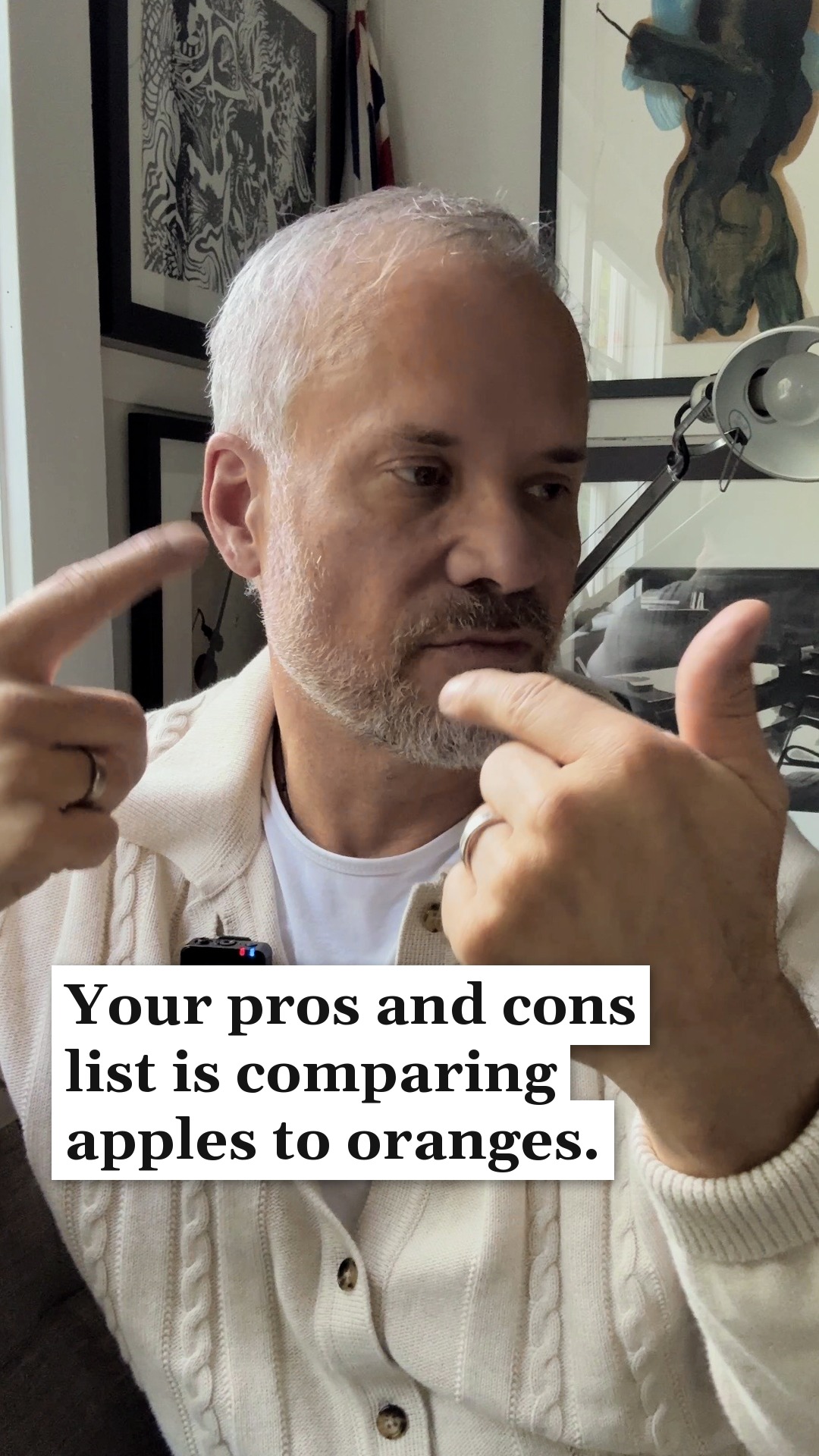
That's because the things you list on each side aren't the same kind of thing, so they can't be added up. In the video at the top of this post, I walk you through a simple way to compare your options using your values instead.
Why the list doesn't work.
In chapter 4 of my new book, I write about the Oxford philosopher Ruth Chang, who has spent her career studying hard choices. She says the options at a big fork in the road are "on a par." They differ in kind, even if they're equally important, so neither wins on every measure. Anyone who has made a pros-and-cons list for a decision like this knows what that feels like. The columns are measuring completely different things.
So you're still stuck.
Here's a little hack to use instead.
It's called the Selecting Grid, and it's from chapter 31 of my book. Put each option at the top of a column, and list your values down the side. Then, under each value, ask the same question of each option: "How does this option give me more of this value?" If it doesn't, leave the box empty.
Say you're choosing between a new job that pays more and staying in the job you've got. And let's say your values are Family, Friendships, Financial Security, and Health & Well-Being.
The new job gives you more Financial Security. But the commute and other parts of the new job take away from the other three values. Staying in your current job keeps you home for dinner, closer to your friends, and with more time for the gym. That's three boxes against one, so staying in the job you have wins.
You aren't ranking your values against each other. You're counting which option gives you more of them. In the book, I say the answer is usually obvious within 30 seconds of looking at the grid, because now you're comparing values to values instead of apples to oranges.
You can use the grid any time you have a big decision to make.
If you don't know what your values are yet, start there.
There are lots of ways to find out in the other videos in this series. One of them is a quick quiz I wrote about in The Ancient Secret to a Tranquil Life, which tells you where your values compass points.
And when you buy my new book, you get to do the Values Identifier Assessment for free. It gives you a 30-page report on What Matters Most to you, based on a billion data points.
Everything gets easier when you know what matters most.
My new book walks you through all kinds of ways to identify (and use) your values. It's called The Values Map. Get your copy today; I’ll be very grateful if you do. ❤️